Published: November 24, 2025
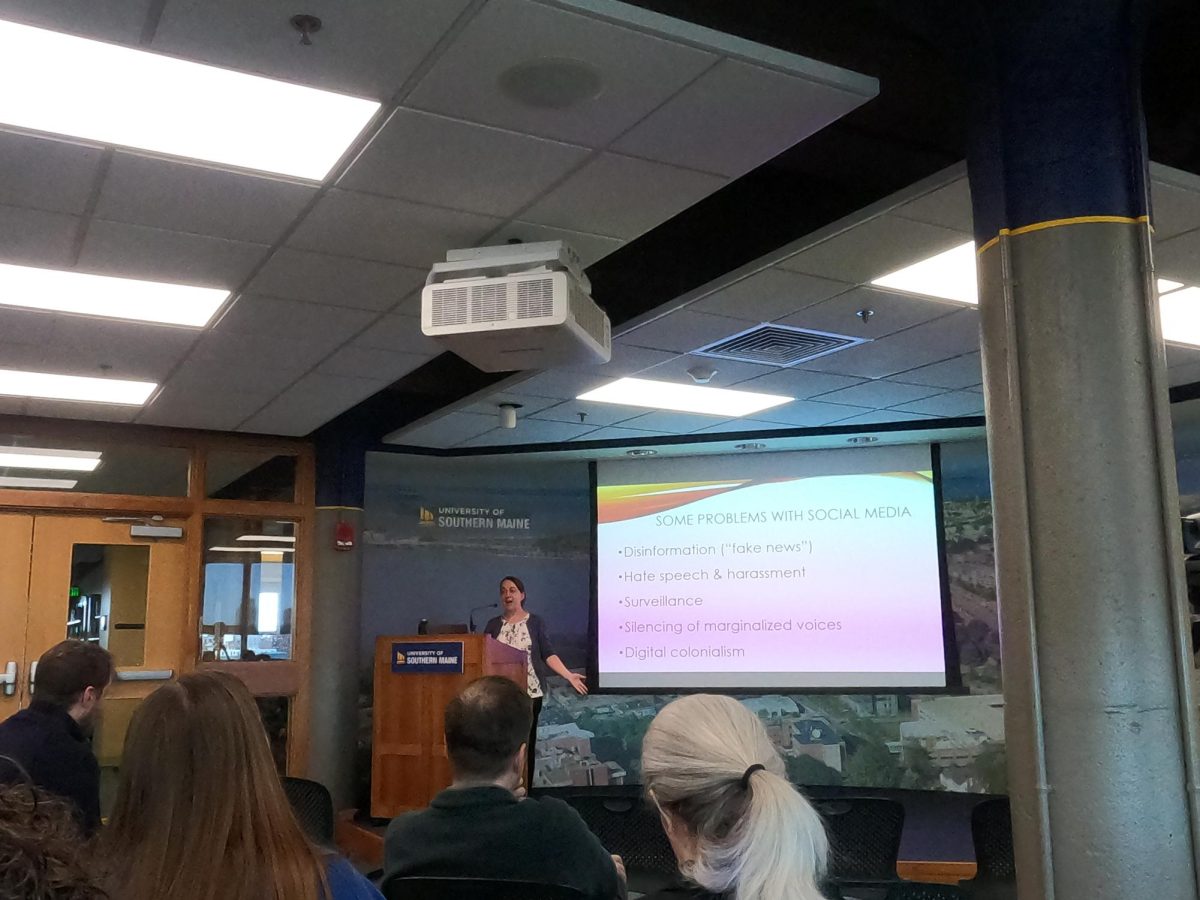
Professor Karen Frost-Arnold offered philosophy as a solution to social media’s woes in her lecture “What Will it Take to Fix Social Media” as part of the Louden Family Lecture Series on October 23, 2025. Professor Karen Frost-Arnold of Hobart and William Smith Colleges, and the author of the forthcoming book, Who Should We Be Online? A Social Epistemology for the Internet openly admits that social media adds a lot to our lives. Therefore, the focus of the lecture was centered on how social media can be fixed to benefit all users using philosophical concepts or more specifically epistemology.
Epistemology explores the nature of knowledge, which is incredibly relevant to current social media users who are routinely bombarded by the outpouring content. As content producers compete for attention, the question remains as to whether social media users are being fully exposed to a range of experiences that allow the formation of a robust base of knowledge that enriches our lives. Professor Frost-Arnold doubts that social media in its current form is achieving this ideal. In her viewpoint, there is a myth that social media is a free-for-all, but this is far from the truth. Instead, she argued that social media is a “tightly controlled, moderated space.” These controlled spaces are predominately dictated by the rules imposed by the tech community in Silicon Valley. Professor Frost-Arnold emphasized that “those decisions are not being made democratically.” The result, according to her, is that marginalized voices are at a heightened risk of being silenced, and when these voices are silenced, it curtails the knowledge of social media users. The production of knowledge is curtailed and disrupted when social media users are being systematically situated away from content that is away from their social location, or what Professor Frost-Arnold defined as who we are and our place on the social hierarchy. Our social locations influence what we know, which is why Professor Frost-Arnold intentionally uses social media to follow people who are different from her and she encourages the audience to do the same.
Despite these issues, Professor Frost-Arnold explained how epistemic-based values can assist with fixing social media by creating a more democratic environment. For example, epistemic advantage is rooted in valuing the knowledge produced by oppressed voices. Professor Frost-Arnold posits that social media can be fixed if we follow this example of valuing marginalized voices, and she explained that social media that is not controlled and designed by corporate entities are most poised to do so. She believes that while “profit-driven corporate social media companies located in countries like the U.S. and China impose their own biased order,” we should move toward alternative social media platforms that are open sourced, equipped with independent servers, and populated by communities that set their own moderation rules. In short, Professor Frost-Arnold relayed to the audience the importance of social media platforms with democratic operation where users “own their social media space.” Once the floor was opened to questions at the end of the lecture, Professor Frost-Arnold actively nurtured the lively discussion that ensued. Many of the attendees were students of Professor Glorianne Schott from the Department of Communication and Media Studies. She commented on how Professor Frost-Arnold’s lecture brought awareness to well-resourced and powerful entities influencing who and what is visible on social media. Professor Frost-Arnold was heartened by the enthusiasm of the audience and encouraged students to explore social media platforms outside of corporate control since social media deeply impacts how we learn.