Published: September 8, 2025
In the grueling summer heat of East Rutherford, New Jersey, the whistle blew for full-time at the biggest soccer game of the summer on July 13, 2025. Chelsea — in a shockingly decisive fashion — had just decimated European Champions Paris Saint-Germain in the final of the new Club World Cup. As the jubilant scenes commenced at full-time, Chelsea captain Reece James took the stage with his teammates to claim their medals and the glittering Club World Cup trophy. As James went to hoist the impressively designed goldware with his teammates in a statement of victory, what were gleeful expressions among the players morphed into pure bewilderment. On the stage, in the middle of a sea of Chelsea players, was Donald Trump, shamelessly intruding upon their trophy lift. As it became evident that he would not leave the stage to allow the players to parade their own hard-fought victory, the tainted celebrations took place around the unmoving President as he beamed towards the cameras. Before our eyes, what should’ve been Chelsea’s crowning moment became Donald Trump’s headline.
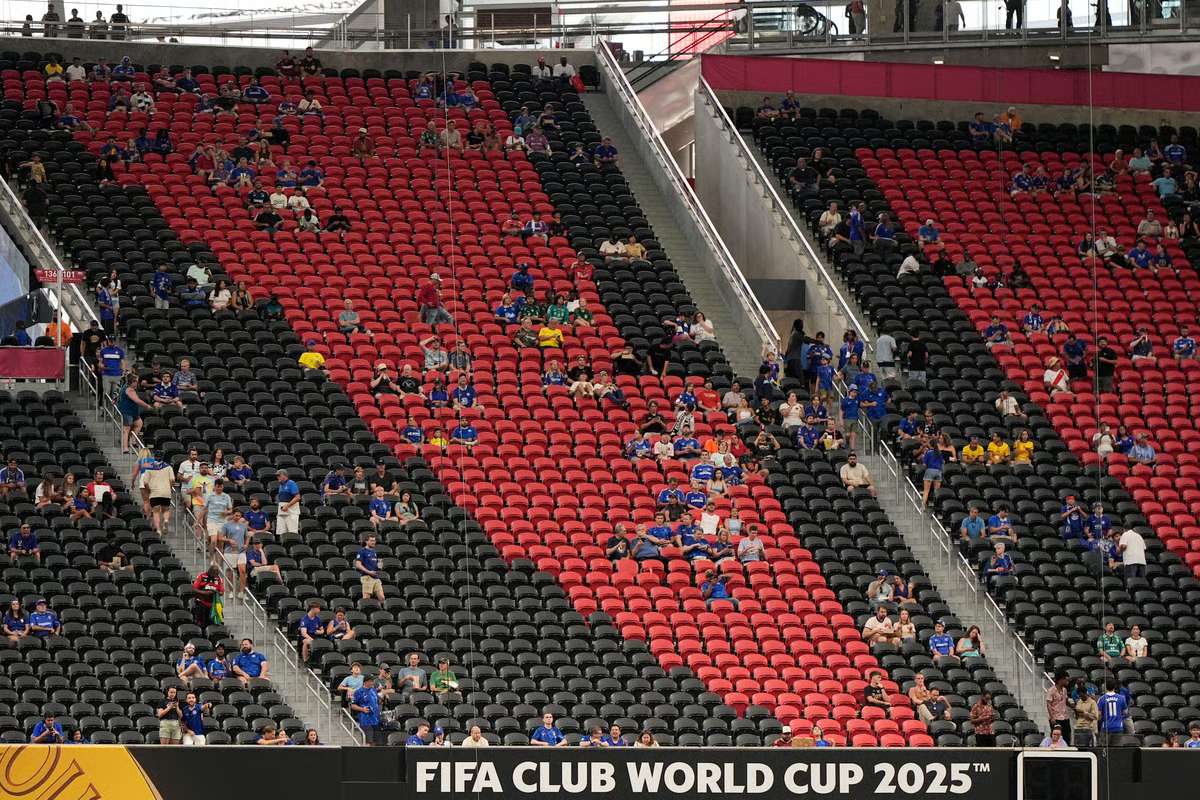
Beyond the President’s obvious need to insert himself wherever the spotlight may be, this new Club World Cup tournament was not exactly the resounding success that FIFA anticipated it would be. Coming off the back of a physically and mentally demanding season for many of the players involved, many fans and footballing icons were questioning the need to host such a demanding competition. The first of its kind, much of the tournament was defined by empty stadiums, awkward ceremonies, political controversies, and player injuries. And with a distinctly Americanized production put on for almost every match — from individual player walkouts to the deafening scream of: “Let’s get ready to rumble!” prior to kickoff — the Club World Cup was a departure from the more traditional presentation and format that the sport is known for. Yet, the Club World Cup ultimately served as a trial run for what will be the main event next summer: the 2026 FIFA World Cup.
As the most globally coveted and competitive competition in the world, the World Cup is a sacred footballing tradition to fans across the world. Hosted by a different nation(s) every four years, each rendition of the tournament provides a new platform for some of the most iconic sporting moments. But due to the alluring magnitude of such an event, money and politics will often, unfortunately, take priority over the interests of fans and players. The previous World Cup, hosted by Qatar in 2022, was met with widespread criticism surrounding the country’s alarming human rights record, particularly regarding the restricted rights of women and LGBTQ+ individuals in the country. While FIFA insisted on keeping politics out of the 2022 tournament, it was evident that the organization cared more about the profits of hosting the tournament in the Middle East as opposed to humanitarian issues. Ironic, now, given President Trump’s significant media presence during the 2025 Club World Cup.
Considering FIFA’s apparent political hypocrisy, it is difficult to envision a promising World Cup in the Americas given the current political landscape of the United States. Indeed, there is a very tangible risk that travelling fans could be detained at airports and borders due to the aggressive immigration policies of the Trump administration. Qualified nations like Iran and Jordan face an even greater risk of political violence and travel concerns next year as tensions in the Middle East loom — especially since the U.S. just carried out an air strike on Iran in June of this year.
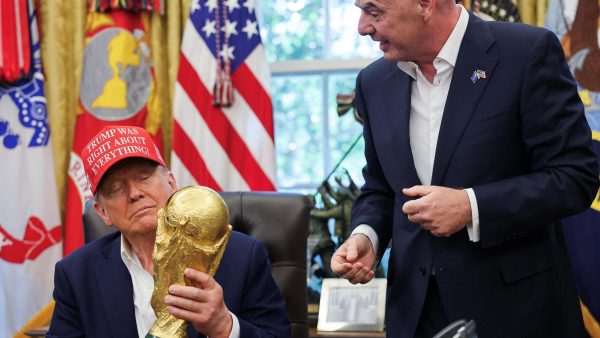
Given these concerns, one might expect FIFA to distance itself from (or ideally, condemn) the surrounding political controversy — as they did with Qatar in 2022 — but the organization has seen to it that President Trump should play a prominent role in promoting the upcoming 2026 World Cup. Recently, FIFA president Giovanni Infantino hosted a press conference with Donald Trump in the Oval Office to announce that the World Cup draw will take place in Washington, D.C. instead of Las Vegas as originally planned. More than likely, Trump will see to it that he headlines the event. The announcement ended with a presentation of the World Cup trophy, with Infantino labelling Trump as a “winner” and allowing him to hold the hallowed goldware — a damning visual. FIFA, clearly, is unperturbed by the problematic politics of the Trump administration and the threats that they pose to international fans and players.
Ignoring the politics of it all, other issues continue to plague the buildup to the tournament. It has already become apparent — as evidenced by the sparsely packed stadiums throughout the Club World Cup — that the United States’ infrastructure is simply not built to handle a tournament of this nature. Unlike tournaments past, many of the World Cup matches will be played in American football fields — fields that are completely removed from their respective cities. Miami’s Hard Rock Stadium, for instance, is roughly a half-hour drive from the Miami International Airport and Downtown Miami with standard traffic. With limited public transportation options in the city, ticket holders must either budget for a rental car or pay ludicrous fees for ridesharing apps. Attending these matches will not only be expensive, but almost inaccessible.
State and city governments have been struggling to meet FIFA’s ambitious logistical plans, with host cities expected to fund and develop travel options to help secure match attendance. Because so many places in the United States housing underdeveloped rail and bus services, many of these host cities are scrambling to find a way to accommodate such massive infrastructural developments so as to comply with FIFA’s demands. And while the Federal government is funding security for the competition, mass-scale events of this nature have historically been the target of horrific instances of gun violence in this country. The antagonistic rhetoric and treatment of foreigners by the Trump administration only further heightens this threat of violence — how can international fans confidently feel safe attending matches in a place that views them with such hostility?
It is clear that the prospect of the United States hosting the biggest tournament on Earth is a mouthwatering ego trip for Donald Trump. He will smugly sit in his Oval Office with Chelsea’s trophy decorating his gold-studded workspace, relishing every morsel of attention he receives as he inserts himself front and center every moment he can into the biggest sporting event on the planet. Meanwhile, international fans and American cities will struggle to afford such exorbitant prices and ambitious demands from FIFA. The unfortunate reality is that FIFA will know all of this, but so long as the money keeps flowing — which it almost certainly will during a World Cup year — they have no motivation to reevaluate their business anytime soon.