Published: March 9, 2026
Have you ever found yourself on the side of I-295 with a flat tire, or in the parking garage with a car that won’t even start? Or maybe you’ve felt out of place in the Autozone parking lot trying to figure out just where that fluid goes… This column can teach you a few quick and easy car skills so you don’t have to call your dad next time something goes wrong.
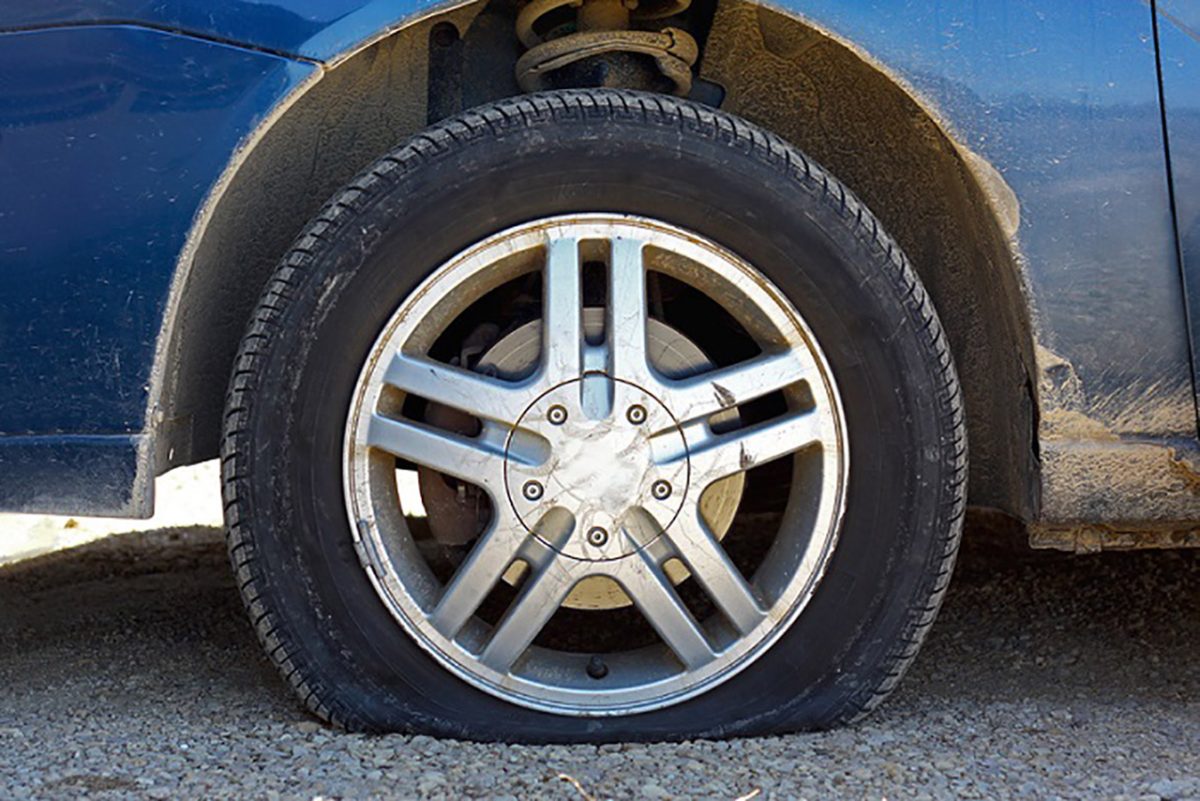
Getting a flat tire is a classic car crisis, but not one that you should panic about, since it’s often pretty easy to fix. If you find yourself with a flat or blown out tire on an active road or highway it is important to create as safe a space as possible to change the tires. Pull as far off the road as possible and put your hazards on. Now it’s time to locate your spare tire, tools and any additional emergency equipment. For cars and small SUVs you’ll find your spare tire under the floor panel of your trunk. For larger SUVs and trucks the spare is often attached to the frame underneath the car. In addition to the tire you’ll need to find the following tools:
- The scissor jack. A folded square with a rod though it.
- Some cars may also have a tool to crank the jack which will look like a hooked rod with a hump in the middle.
- The tire iron or lug wrench. A cross or L-shaped tool with large hex sockets on the end.
- You may also find reflective signs or even flares alongside these tools, place the signs at intervals behind your car to alert other drivers, and use the flares if it is dark.
Now that you have your tools and tire you can get to work. To start, you’ll need to jack your vehicle up first. There are three main jack points that you’ll find depending on your vehicle and provided jack. This is the most dangerous part of the process and has the most potential for damage to your vehicle or self if done incorrectly.
- Most common on cars and small SUVs. Pinch welds are a small ridge underneath your car where two pieces of metal meet. If your jack has a similarly sized U-shaped notch, you’ll place it so the ridge fits directly into the jack.
- Flat jack points, located towards the inner corners near your tires. These are less common and will be used if your jack has a flat top.
- For large trucks and SUVs you’ll place your jack on the ladder frame of your vehicle, the large structure under the cab, these will also be used with a flat top jack.
Test your jack points for rust using whatever you have on hand, some surface rust is okay, but if you poke a screwdriver or other object though your jack point it may be time to call a tow truck. Additionally, NEVER place a flat topped jack under a pinch weld, or a pinch jack in a way that does not nest the weld ridge into the jack. Doing this can cause severe damage to your car.
Place your jack on a jack point under the passenger area of your car and as close as possible to the tire you need to change. Make sure the ground underneath the jack is solid, asphalt and concrete are best, for gravel or dirt find something additional to place under the jack.
Next comes the scary part, you’ll use either the tire iron or the jack crank to lift the car, these will attach via a hook or a hex to the rod in the jack. Begin to turn the tool clockwise, and you should see the jack rise (as the jack gets closer to your pinch weld make sure it seats correctly). Once the jack applies pressure to the car the turning will get significantly harder, keep going you’re not going to break anything. You only need to lift the car enough for the affected tire to be about half an inch off the ground.
Now that your tire is off the ground, double check that your jack is stable and start to remove the lug nuts or bolts. You may need to use a lot of force, sometimes even standing on the tire iron to break these free at first. You don’t need to worry about breaking anything, your car and these tools are built for this. Break all 4-6 bolts loose and then remove them fully, I recommend placing them in the cupholder of your car so you don’t lose them. Remove the affected wheel and tire and grab your new one. Smaller cars may have a “donut” spare, a smaller and thinner spare that will need to be replaced quickly while larger trucks and SUVs will have a full size spare that looks identical to the one you replaced and can be driven on normally.
Place your new wheel and tire back on the hub and grab your lug nuts and bolts and thread them back in by hand to avoid cross-threading. Use the tire Iron or lug wrench to tighten all your lugs back in a star patter to ensure even tightness distribution. Give each bolt one final tighten as hard as you possibly can and lower the jack by slowly turning it counterclockwise.
If you have a donut spare, get your tire replaced ASAP and avoid driving over 50mph. If you have a full size spare use a torque wrench or have a shop tighten that wheel to the factory specifications.
Congratulations! you now know how to change a tire, you’ll be able to change one much easier next time it happens to you, and you’ll be the coolest person in the room if it happens to a friend!