








WESTBROOK — After years of delays, legal disputes, and growing community speculation, Vertical Harvest’s massive hydroponic greenhouse is finally producing food in Westbrook — though the facility remains far from full capacity.
During a recent tour, employees were seeding pea shoots, conveyor systems moved growing trays through the facility, and company leaders said commercial shipments have been underway since February. Yet questions remain about production levels, hiring, and the greenhouse’s long-term future.
Inside the Greenhouse
On June 22, I toured the Vertical Harvest facility in Westbrook, where employees offered a glimpse into a greenhouse that is still growing into its full potential.
Upon entering the towering building, Lindsay, a member of the Vertical Harvest team, walked me through it.
On the first floor, there is a “welcome center,” which, despite being pretty empty currently, promises to eventually be a place where locals can come in and try the produce for themselves.
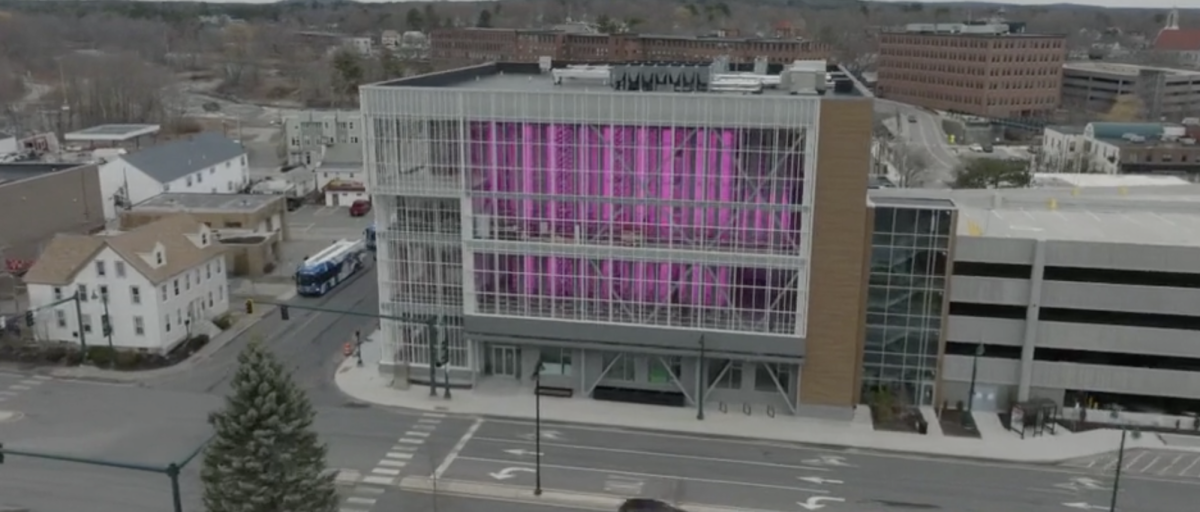
Though built on just one acre of land, the vertically stacked hydroponic growing systems allow the greenhouse to produce the equivalent of about 250 acres of traditional farmland.
From what I observed during my tour, production is not yet operating at full scale, though cultivation is clearly underway. Inside the hydroponic greenhouse, crops are grown on trays that move through different stages of production, from seeding to harvest. At any given time, the facility can hold thousands of growing trays, allowing plants at different stages of development to be cultivated simultaneously. 42,000 trays would be needed to fill the entire building. The trays will move throughout the facility on a variety of conveyor belts that run throughout the building.
In terms of staffing, Lindsay described to me the small team, saying that the facility currently employs five people. However, they expect to expand staffing as production increases.
“It’s gonna be soon. It has to be soon,” she said of officially hiring additional employees.
Although hiring is not in full swing, Lindsay said Vertical Harvest has already interviewed prospective employees who are ready and eager to work. For now, the focus remains on getting the greenhouse and support systems in place so the organization can grow thoughtfully and set employees up for success.
The company hopes that, eventually, 40% of its workforce will be made up of people with disabilities, reflecting the mission that has guided Vertical Harvest since its founding in Wyoming. Both Nona and Lindsay have reiterated that this is a core mission of the organization.
During my visit, three employees were busy seeding pea shoots. While peas were the only crop I observed in active production during my tour, Lindsay said the greenhouse is currently growing greens and microgreens as well.
Produce is harvested early in the week, primarily Monday through Wednesday, with the distributor Native Maine picking up orders on Thursdays.
Some sections of the facility, including the germination room, are not yet fully up and running. This serves as a visible reminder that the greenhouse remains in a ramp-up phase.
Lindsay described the process as gradual but intentional, detailing the slow ramp-up that Nona Yehia, the CEO of Vertical Harvest, has previously discussed. The team is focused on building a reliable, growing operation before expanding production further.
Lindsay also spoke about the company’s desire to become more involved in the community, including volunteer work and future donations of produce to local food pantries. Employees said they hope the public knows that Vertical Harvest is now operating in Westbrook, even if it has not yet reached full-scale production.
Before I left, Lindsay handed me some freshly harvested pea shoots and radish sprouts. They were delicious and incredibly fresh—a small but memorable taste of what will hopefully become a major source of locally grown produce for Maine later this year.
An Interview with the CEO
What I observed during the tour largely reflected what company leadership says is a deliberate, though slower-than-expected, ramp-up process. Earlier this month, I had the opportunity to speak with Nona Yehia, who is optimistic about the Maine location’s future.
“Our 10 years in Jackson Hole, Wyoming, proved the model out in multiple ways before we scaled,” she said.
While the company has begun shipping products commercially, Yehia acknowledged that reaching full production has taken longer than originally anticipated.
“We have been shipping commercially, using Native Maine, and you can actually find us at Jordan’s Farm as well since February 2026,” she said.
Still, she emphasized that Vertical Harvest remains in a ramp-up phase and is prioritizing consistency over rapid growth.
“We’re here. We’re serving the community in a limited scope, but the plan is to continue to ramp,” Yehia said. “We’re really excited to be in the community and really appreciate the community’s patience as we ramp slower than expected.”
The company has previously discussed supplying major retailers, food service providers, and institutions throughout Maine and New England. Specifically, the business had expressed goals of working with Sodexo and Hannaford.
However, Yehia said the focus for now is on ensuring the greenhouse can consistently produce high-quality crops before expanding distribution.
“We are earlier in ramp than our original plan, and I’m focused on what is in our control right now, which is the quality of the food, the food safety, and the reliable supply of what we can produce right now,” she said. “That foundation really matters for long-term sustainability, and it matters more than rushing volume.”
In reference to alleged legal and financial troubles, Yehia said, “There are external factors that we are working through that I can’t go into in detail while they’re in progress.”
Despite those challenges, Yehia said the company’s mission remains unchanged from when Vertical Harvest was first founded: growing food close to the communities it serves.
“The real intention is proximity,” she said.
Comparing Vertical Harvest’s approach to Maine’s craft brewing industry, Yehia said the company hopes to complement rather than replace traditional agriculture.
“I like to say that we are like what local craft beer is to industrial lager,” she said. “We are able to support the local community.”
The Reaction from the Maine Community
While company officials remain optimistic about the greenhouse’s future, many members of the Maine community continue to have questions about the project’s status and timeline.
One of the most common questions has been about production and distribution.
“Where are these products produced in Westbrook and being sold at?” a Westbrook community member questioned.
Others have expressed frustration over what they perceive as a lack of communication and transparency from the company. “It is certainly a mystery, isn’t it?” another resident said.
Many of these questions and concerns appear to stem from the company’s previously reported legal and financial challenges.
At the same time, some community members have defended Vertical Harvest, encouraging others to “give them some slack” while also asking where they can find and purchase the greenhouse’s products.
In early May of this year, a Westbrook resident took to social media to ask, “Why are all the blinds shut in the Vertical Harvest building?” They added, “Weren’t those windows for the sun to enter?”
Westbrook Mayor David Morse responded, explaining, “They don’t use sunlight; they use those pink LED lights for growing the plants. The blinds are there because without them, you’d see bright lights all night.”
The exchange sparked additional discussion about the project, with residents weighing both its potential benefits and ongoing uncertainties.
“I wish I knew more about what’s happening here,” one community member said. “The project seemed exciting at the outset – then plans changed so much during construction… I’ve heard no communication from the company about who they are as corporate citizens of Westbrook.” They added, “It’s troubling, almost creepily quiet.”
The Origins of Vertical Harvest
To understand why the Westbrook greenhouse has attracted so much attention, it helps to understand the origins of Vertical Harvest and the mission behind the company.
Vertical Harvest began as an ambitious idea in Jackson, Wyoming, in 2010. Faced with a small, oddly shaped plot of land and two pressing community challenges (limited access to fresh produce and a lack of employment opportunities for people with disabilities), the town sought an innovative solution.
According to Vertical Harvest’s website, Jackson imported more than 90% of its fresh produce, while many residents with disabilities faced barriers to finding meaningful employment. The organization was founded on the belief that one project could help address both issues: growing food locally while creating inclusive career opportunities.
That vision led to the creation of Vertical Harvest, a hydroponic greenhouse system, which became North America’s first vertical greenhouse. After years of planning and construction, the flagship facility officially opened in Jackson in 2016, serving as a model for combining sustainable agriculture with workforce inclusion.
The Expansion to Maine
That mission eventually led the company to Maine, where leaders saw an opportunity to bring the model to a region with a short growing season and a strong interest in local food production.
Plans for a Vertical Harvest location in Maine were first announced in July 2020.
The Westbrook operation, located at the intersection of William Clarke Drive and Mechanic Street, is approximately four times larger than the Jackson greenhouse and contains roughly 20 times more growing space. Once fully operational, the facility is expected to produce more than 3 million pounds of leafy greens annually. According to the company’s website, this would be “enough to help meet the New England Food Vision’s goal of producing 30% of food locally by 2030.”
Evidently, this project has been years in the making. Groundbreaking took place in 2021, and the expected opening date was pushed back several times. However, the facility did begin distributing its first crops this year, in early 2026.
Company officials have said the Maine greenhouse incorporates lessons learned from years of operating the Jackson facility. During the development of the Westbrook project, the Wyoming operation underwent significant infrastructure upgrades and temporarily paused production while the company refined its growing systems.
The ambitious scale of the Maine greenhouse comes at a time when the controlled-environment agriculture industry has faced growing economic pressures. Several vertical farming companies nationwide have struggled financially or filed for bankruptcy in recent years as operators grapple with high construction, labor, and energy costs.
Alleged Legal Troubles in Maine
Despite the company’s ambitions, the Westbrook project has faced a number of financial and legal challenges throughout its development.
Vertical Harvest Maine received significant public financing, including a $48.7 million loan guaranteed by the U.S. Department of Agriculture and a $1 million direct loan from the Finance Authority of Maine.
The company is also facing a lawsuit filed in Cumberland County Superior Court by Waterside Commercial Finance, a Canadian brokerage firm that helped arrange the USDA-backed financing package.
According to the complaint, Waterside was owed a brokerage fee tied to the financing and alleges that Vertical Harvest and its financial partners failed to meet repayment obligations. The lawsuit further alleges that company officials concealed a later capital infusion that should have triggered repayment.
Yehia has continually declined to discuss specific allegations because the litigation is ongoing, but disputed portions of the complaint.
“Obviously, it’s an ongoing dispute, and it’s from a complex relationship,” Yehia said. “There are some things we don’t agree with, and we feel have been mischaracterized, and we’ll address [it] through the appropriate channels.”
The lawsuit follows other financial challenges. In 2025, the City of Westbrook filed a tax lien against the property over unpaid taxes. At the time, Yehia said the company was working with the city to resolve the matter and described it as a temporary issue.
What’s Next?
Whether Vertical Harvest ultimately reaches its ambitious goals remains to be seen. The company is still ramping up production, navigating legal challenges, and working to earn the trust of a community that has spent years waiting for answers.
Perhaps the biggest test lies in the months ahead. As Lindsay noted, the company hopes to become more involved in the local community this summer. By fall, it should become clearer whether Vertical Harvest can successfully ramp up production, distribute more locally grown produce, and expand its workforce as planned.