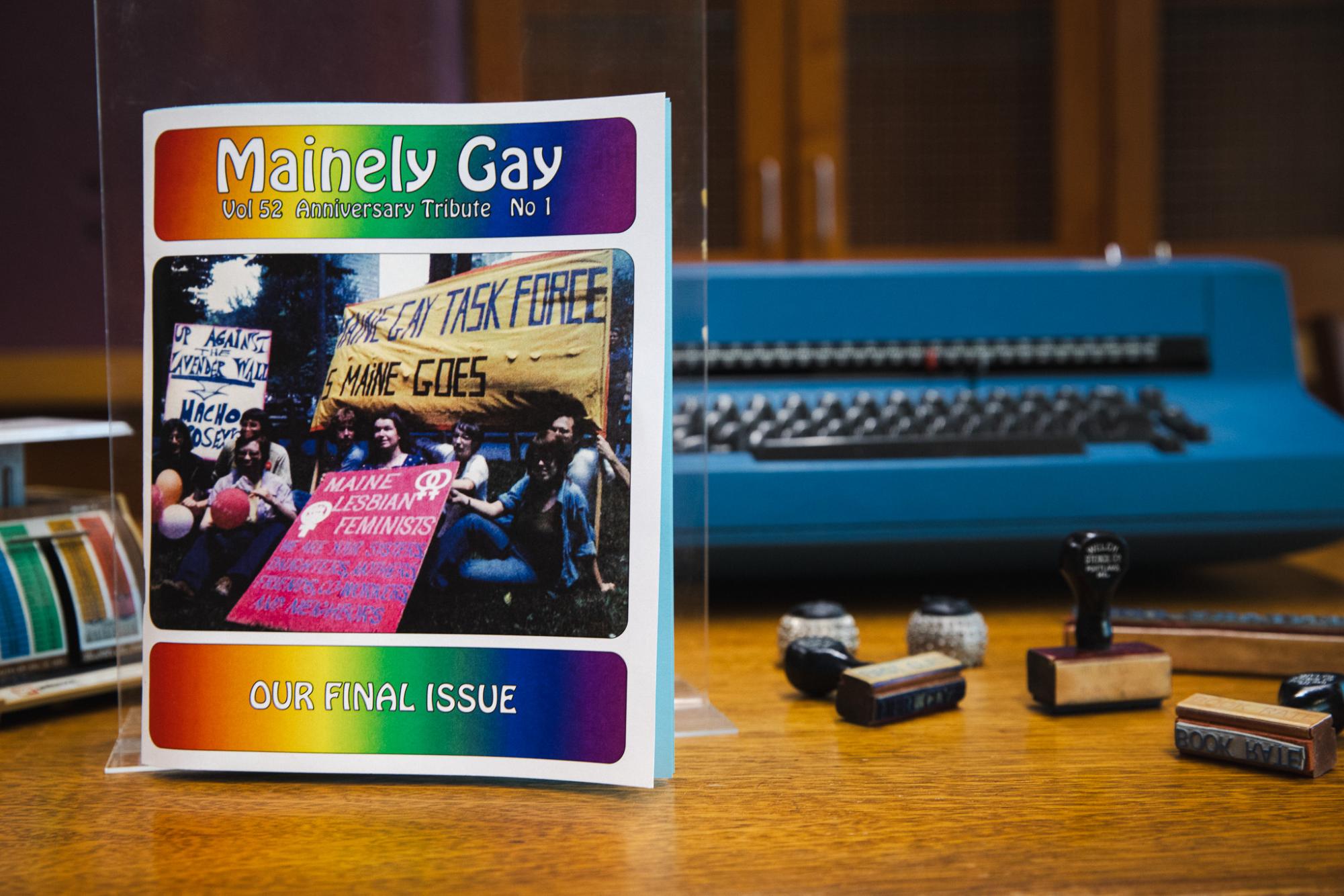
PORTLAND, Maine — More than five decades after publishing Maine’s first gay newspaper, the founders of “Mainely Gay” have released a 50th anniversary edition that will be added to the University of Southern Maine’s Special Collections — the largest collection of LGBTQ+ archival materials in the state. USM is distributing the edition at Pride events across Maine and will host a public panel discussion and display of original materials from the publication on June 25.
“The Maine Gay Task Force Newsletter” emerged in 1974 from the first Maine Gay Symposium held at the University of Maine at Orono. Typed, photocopied, and hand-distributed by a small group of activists from across the state, the newsletter remained in print until 1976, when it expanded into a full newspaper under the name “Mainely Gay.” It ran until September 1980, documenting the state’s LGBTQ+ movement through major legislative battles and inspiring more than three dozen other community publications.
USM’s Special Collections holds the original run of both publications — part of a larger archive that has kept Maine’s LGBTQ+ history accessible for decades.
“We bring classes in all the time from a variety of disciplines,” said Susie R. Bock, coordinator of Special Collections and director of the Jean Byers Sampson Center for Diversity in Maine. “I’ve had a high school-age student say to me, ‘Oh my God, a university is collecting on me, on my people.’”
The 50th anniversary edition brought together four of the founding editors — Peter Prizer, Steve Bull, Stan Fortuna, and Susan Henderson — alongside writer and researcher Vachon. The edition marks five decades since the newsletter’s founding, and is being distributed at Pride events across Maine this June.
“I think that everyone who wrote, or contributed to this final issue was aware that it would stand as an epilogue, so to speak, to a remarkable time in Maine when the very first organized queer movement began,” Prizer said.
Later this month, Bull, Prizer, and Vachon will join USM Special Collections for a panel discussion celebrating the milestone.
“I want the current generation to be familiar with the rich history in Maine,” Bull said. “At conferences in the 1970s, we talked about how queer history had been erased — we knew we had to document our own history. If not, it would not get done. USM has a gem that should be nurtured.”
The collection is available digitally through USM’s Digital Commons, and USM Special Collections welcomes ongoing manuscript and artifact donations to preserve Maine’s LGBTQ+ history.
“By preserving and sharing these materials, we’re making sure this history is visible and accessible, and showing that USM is a place that accepts everybody,” Bock said.